# Introduction

<figure><img src="/files/YNwXs5QVU7v6UjSmThKb" alt=""><figcaption></figcaption></figure>

Uniwhale is an oracle-based perpetual DEX where you can trade, with up to 200x leverage, BTC, ETH, and many mainstream crypto assets, directly from your wallet.

As a liquidity provider, you can provide liquidity with stablecoins like USDT, USDC, BUSD, and more, to earn real yield from market-making and leverage trading.

Based on objective price oracles and single-sided liquidity, Uniwhale aims to deliver the best trading experience for traders with zero credit risk and minimize impermanent loss for liquidity providers.

* Oracle-based price execution means zero slippage.
* Single-sided stablecoin liquidity means zero impermanent loss.
* Decentralized on-chain trading experience means zero credit risk.

## Uniwhale infrastructure is fully decentralized

* We provide fully decentralized web links. You can run locally if you like.
* Connect through <https://uniwhale.co> for speed and convenience.
* Use any IPFS gateway to use the service even when the main website is not accessible.
* Mitigate DDOS attacks.
* Unique CID makes our app immutable, mitigating MITM attacks.
* Censor-proof distribution, we will live no matter what.

<figure><img src="/files/7Xf7XIe69Wvmherf2zIh" alt=""><figcaption></figcaption></figure>

###


# Our Vision

<figure><img src="/files/MEwMt7IWcwb76jNtGlSW" alt=""><figcaption></figcaption></figure>

## In Code We Trust

Back to where it started: Satoshi created the vision and practical path of a trustless solution - Bitcoin. Code never lies, and saves us from having to trust a centralized authority. &#x20;

DeFi, as an alternative to CeFi, provides full on-chain transparency and a strict limit on the use of user funds. With code, credit risk can be made minimal.

## Permissionless, Trustless, Transparency

Not we, but our community decides who has the right to use and benefit from the platform. We believe in the power of full decentralization and permissionless, trustless, transparency.

Uniwhale team is committed to contributing and bringing this vision of the platform to our community, incentivizing everyone to participate in the DAO to BUILD together.

## Best User Experience

Unknown slippage, uncontrolled impermanent loss, complicated UX, inflated farming yield - we see many issues in the current DeFi protocols. We are a team of web3 developers/builders, joining the efforts to address these issues.&#x20;

We aim to bring the best trading experience to traders, and the most intuitive liquidity provision to liquidity providers, but without harmful token price volatility. &#x20;

## Who We Are

Goodsanai - Chief Architect | Smart Contract Builder | Risk Management | ex-Wallstreet Quant

Sophon - Core Contributor | Business Development | Tokenomics Advisor | ex-Wallstreet Quant

Weller - Chief Product Design | Operation & Marketing | Community Lead | Web2 veteran & CMO&#x20;

Orca - Decentralized Dev | Full Stack | Day Dreamer & Night Coder | Web2 veteran & CTO

Bok - System Architect | Optimizer | Perfectionist | Data Analyst&#x20;

Catt - Community Lead | NFT Degen & Advisor | Serial Entrepreneur | Product Design

Coral - Designer | Researcher | User Experience Designer&#x20;


# Unique Oracle Design

<figure><img src="/files/PAFeXrSUW67GTCrbcB93" alt=""><figcaption></figcaption></figure>

## Mitigate harmful candlestick wicks&#x20;

Uniwhale does not require active market making by market makers, but instead relies on oracle prices to execute trades.

Oracle-based trade execution is designed specifically to mitigate harmful candlestick wicks, which so often liquidates, often unfairly, perpetual futures traders.

<figure><img src="/files/LvTjOBIKhkyhfKIHDfig" alt=""><figcaption><p>Harmful candlestick wicks can wipe out levered long/short positions right before a significant rally/drop</p></figcaption></figure>

Such harmful wicks can be caused by many factors, but mainly we are concerned that these are often the result of illiquid/wrong/manipulated prices/pricing sources.

Oracle-based trade execution mitigates such harmful candlestick wicks because the oracle prices are published based on aggregate data contributed by multiple data sources. This makes it almost impossible to create such illiquid/wrong/manipulated prices/pricing sources-driven wicks.

## Pyth Network

Uniwhale uses [Pyth Network](https://pyth.network) for its oracle prices. Pyth Network is an oracle that publishes financial market data to multiple blockchains. Market data is contributed by over 70 [first-party publishers](https://pyth.network/publishers/), including some of the biggest exchanges and market making firms in the world. Each price feed publishes a [robust aggregate](https://docs.pyth.network/how-pyth-works/price-aggregation) of publisher prices that updates multiple times per second.

Pyth Network is different from many other oracles in that it uses ["on-demand" price update model](https://docs.pyth.network/consume-data/on-demand), whose advantages over the more traditional "push" model, among many, we like are:&#x20;

* Gas efficiency: On-chain prices are only updated when they are needed.
* High update frequency: Pyth Network price feeds update once per second, which is faster than the blocktime of most blockchains.
* Low latency: Every transaction can use a recent off-chain price, instead of relying on the last on-chain update pushed by the oracle itself.
* Reliable in volatile conditions: On-demand model does not fail to land price updates in volatile market conditions, because price updates are incorporated into the valuable transactions themselves (and therefore can compete for bandwidth).

### Latency

Any protocols dependent on oracles must account for the difference in latency between on-chain oracles and off-chain sources (e.g. centralized exchanges). No on-chain oracle can match the latency of an off-chain source due to the added overhead for consensus and security. Therefore, protocols must assume that there will be players who see price changes slightly before the protocol does. [Pyth Network](https://docs.pyth.network/consume-data/best-practices#latency) describes this situation as follows:

`This situation is analogous to market making in traditional finance. Market makers place resting orders on exchanges with the hope of earning the bid/ask spread. When the “true price” moves, these market makers get picked off by adverse “smart flow” that is faster than they are. The smart flow is balanced by two-way flow, that is, people wanting to trade for other reasons besides a price change.`<br>

The last sentence of the above quote is also important, because this relates to a key assumption of an oracle-based execution venue - that the objective oracle-based execution can create a better two-way flow, whose benefits then far outweigh its shortcoming. We then [tune the bid/ask spread and offered liquidity](/trading#risk-management) to limit adverse selection from smart traders while still interacting with two-way flow.

Further, we give ourselves a "last look" to decide which trades to accept, based on the following conditions:

* Price is not stale: last slot update is not too far behind the current slot;
* Price is not negative;
* Price is not too volatile: EMA/spot ratio is less than 5, and;
* Price is not too uncertain: confidence internal is less than 10%

If Price do not meet the above conditions, then the trade is rejected.

### Price Availability

While Pyth Network provides a good protection against returning a stale price, the main public endpoints for its price service, operated by the Pyth Data Association, are centralized and therefore create risks for the protocols using its service.

The price service listens to the Wormhole Network (which has built in redundancy and is therefore inherently more reliable) for Pyth price updates and is a critical component used by Uniwhale Exchange app to fetch on-demand price updates.

To mitigate this risk, Uniwhale Exchange is built on its own custom network of 8 price services, whose weighted average (using the slot-weighted/inverse-confidence weighted scheme like [EMA price aggregation](https://docs.pyth.network/how-pyth-works/ema-price-aggregation)) is then submitted for on-chain price update and trading.&#x20;

Our custom price service network therefore provide for maximum resilience and decentralization.

### Oracle network health

You can monitor the health of Pyth Network at [Dune](https://dune.com/cctdaniel/pyth-oracle).

## What the future holds

Our oracle infrastructure is built to provide manipulation-resistant prices for trading with focus on latency and price availability.

We, however, also recognize that our entire infrastructure, built around Pyth Network, relies on a single oracle protocol, however decentralized it may be.

As part of the product roadmap, we are building a custom oracle aggregator based on multiple protocols (including Pyth) to determine trading prices.

By aggregating and filtering prices across multiple oracle protocols, our oracle aggregator can provide a price that is even more reliable with multiple redundancies.

###


# Trading

<figure><img src="/files/H6UxK17YVjpfhr6LbAKK" alt=""><figcaption></figcaption></figure>

## Trade up to 200X

We offer perpetual futures with up to 200X leverage on BTC, ETH, and many mainstream crypto assets.

## Keep your assets safe

We do not custody your assets. Your assets stay with you and the margins posted are locked in a dedicated smart contract.

## Margining

All positions are margined in USDT.

You can add and remove margins to outstanding positions. When margins are updated to an outstanding position, the relevant liquidation price is also adjusted.

(coming soon) Multiple stablecoins are accepted as eligible margins. These will be swapped automatically to USDT.

## Order type supported

You can trade either Market Order or Market Limit Order. Both order types can also have either Stop Loss, Profit Target, or both.

### Market Order

Market orders are filled at the best price offered by the [Liquidity Pool](/liquidity-pool).

### Market Limit Order

Market limit orders are filled when the limit prices match the best price offered by the [Liquidity Pool](/liquidity-pool).

### Stop Loss

Stop Loss price can be added to Market Order or Market Limit Order, which will trigger an automatic close of the position if the condition is satisfied.

### Profit Target

Profit Target price can be added to the Market Order or Market Limit Order, which will trigger an automatic close of the position if the condition is satisfied.

### Calculation and execution of Stop Loss and Profit Target

Every position is subject to [Funding and Rollover Fee](#funding-and-rollover-fee). Stop Loss and Profit Target prices of a position are dynamically adjusted based on the relevant Funding and Rollover Fee and executed on the adjusted basis. This ensures that the execution of the Stop Loss and Profit Target is in line with the PnL expectation of the trader.&#x20;

So for example, let's assume your position is a buy position with the entry price at $1,000 and you entered a Stop Loss at $800 (i.e. the target maximum loss is 20% before leverage). If the Funding and Rollover Fee is zero, then the Stop Loss will be triggered if Oracle Price is $800. If, however, the accumulated Funding and Rollover Fee is $100, then the Stop Loss will be triggered if Oracle Price is $900 to ensure the target maximum loss expectation (of 20% before leverage) is met.

## Fee and Market Impact

Prices offered by the [Liquidity Pool](/liquidity-pool) embed two types of transaction costs - Fee and Market Impact.

`Long/Short Open Price = Oracle Price x (1 +/- Fee +/- Market Impact)`

`Long/Short Close Price = Oracle Price x (1 -/+ Fee -/+ Market Impact)`

### Fee

Fee is 0.10%.

### Market Impact

Market Impact is calculated dynamically as a function of outstanding positions on the platform and the position size. It is a deterministic charge simulating the impact a new position would have on the market.

`Market Impact (%) = (long/short outstanding positions on the platform + Position size) / 1% depth above/below`

`1% depth above/below` is benchmarked to the corresponding liquidity at leading exchanges and regularly updated.

## Funding and Rollover Fee

Outstanding positions are subject to Funding Fee and Rollover Fee.&#x20;

### Funding Fee

Funding Fee is a dynamic fee charged per block-height that is based on the long/short outstanding position imbalance on the platform and is charged on the position size (i.e. your margin multiplied by the leverage).&#x20;

Funding Fee can be positive or negative, depending on your position relative to the position imbalance on the platform. Generally speaking, you are paid Funding Fee to take a contrarian view, and pay Funding Fee to take a consensus view.&#x20;

Funding Fee protects the platform and the liquidity providers by helping balance the long/short outstanding positions.

`Long Funding Fee Per Block (%) = Base Fee Per Block x (long outstanding position on the platform - short outstanding position on the platform) / long outstanding position on the platform`

`Short Funding Fee Per Block (%) = Base Fee Per Block x (short outstanding position on the platform - long outstanding position on the platform) / short outstanding position on the platform`

`Base Fee Per Block` is different for each crypto asset and is updated periodically.

The definitions above mean the total Long Funding Fee per block always equals the total Short Funding Fee per block, i.e. this is a transmission mechanism by which traders with consensus view pay traders with contrarian view. Therefore, no Funding Fee is paid to the platform or the liquidity providers.

### Rollover Fee

Rollover Fee is a fixed fee charged per block-height on your margin. Because it is charged on your margin, the higher the leverage, the less significant the Rollover Fee is to your overall position. Rollover Fee protects the platform and the liquidity providers by helping level the risk of lower leverage positions with that of higher leverage positions.

`Rollover Fee per Block (%) = Base Fee Per Block x position margin`

`Base Fee Per Block` is different for each crypto asset and is updated periodically.

### Impact of Funding and Rollover Fee to Stop Loss, Profit Target and Liquidation

See [Calculation and execution of Stop Loss and Profit Target](#calculation-and-execution-of-stop-loss-and-profit-target).

## Opening a position

<figure><img src="/files/WXe0poJgPrh4oPb6imkz" alt=""><figcaption></figcaption></figure>

Opening a position will transfer the required margin to a dedicated on-chain contract, whose sole purpose is to hold trader margins.

[Liquidity Pool](/liquidity-pool) which acts as the central counterparty and clearinghouse to all positions.

To open a position, you need to enter the margin you want to put up together with the leverage you are looking for.

(coming soon) You can post margin in many stablecoins, which will then be automatically swapped into USDT using a third-party DEX (e.g. PancakeSwap), with the maximum amount of the stablecoin to meet the USDT margin requirement specified by you.

### Tolerance setting

Your execution price is deterministically calculated (see [Fee and Market Impact](#fee-and-market-impact)) based on the latest oracle price, but, especially during a fast-moving market, there can be a gap between the screen price and the actual execution price (primarily due to changes in oracle price and outstanding positions on the platform).&#x20;

To mitigate this risk, you can specify Tolerance when opening a position, so that the actual execution meets your execution price requirement.

## Closing a position

<figure><img src="/files/YpyyQ3RnLhtLnK3jU6NS" alt=""><figcaption></figcaption></figure>

Closing a position will calculate the PnL based on the best price offered by the Liquidity Pool and transfer it to the trader, together with the margin posted.&#x20;

(coming soon) You may request the PnL to be transferred in a stablecoin other than USDT, in which case the PnL (together with the margin) will be swapped into the requested stablecoin using a third-party DEX (e.g. PancakeSwap), with the minimum amount of the stablecoin specified by you, and transferred to you.

You can not lose more than the margin posted.&#x20;

### Limit Price or Market Price

Your execution price is deterministically calculated (see [Fee and Market Impact](#fee-and-market-impact)) based on the latest oracle price, but, especially during a fast moving market, there can be a gap between the screen price and the actual execution price (primarily due to changes in oracle price and outstanding positions on the platform).&#x20;

To mitigate this risk, you can specify Limit Price when closing a position, so that the actual execution meets your execution price requirement. Specifying a Market Price will simply accept the actual execution price.

## Liquidation

Outstanding positions are subject to liquidation if the relevant liquidation price is breached according to the price oracle.

Liquidation price is adjusted dynamically based on Funding and Rollover Fee in the [same manner as the Stop Loss and Profit Target](#calculation-and-execution-of-stop-loss-and-profit-target).

Outstanding positions eligible for liquidation are liquidated at the earliest chance, to protect the users and the platform.

Liquidation closes the relevant position. It is subject to a liquidation penalty (currently 10% of the liquidation). In order to avoid the liquidation penalty, traders are advised to close a position before liquidation is triggered.

## Risk management

Trading at uniwhale is subject to the following constraints:

* Leverage cannot exceed a cap.
* The number of open positions for each pair a trader can carry is capped.
* The number of open positions across pairs a trade can carry is capped.
* The total margin across pairs a trader can carry is capped.
* Each pair is subject to the maximum total long and short positions.
* There is a minimum position (after leverage) required.
* A position is subject to the maximum percentage PnL, determined as a function of your margin and leverage (see [Maximum Percentage PnL](#maximum-percentage-pnl)).
* The maximum possible PnL of all open positions (long and short) across the platform cannot exceed the prevailing market value of Liquidity Pool.

### Maximum Percentage PnL

At Uniwhale, we must ensure that the platform always stays solvent as positions are opened and closed. That means the counterparty to all the trades, ie. the Liquidity Pool, must be able to meet the maximum possible PnL of all open positions (long and short) across the platform.

Because the maximum possible PnL of long/short open positions, by default, is unlimited/very large, respectively, we apply so-called "Maximum Percentage PnL" to each position, which limits the maximum possible PnL of each position and therefore allows us to determine the maximum possible PnL of all open positions.

To determine Maximum Percentage PnL, we take into consideration the leverage of a position, and the higher the leverage a position has, the higher its Maximum Percentage PnL subject to a cap and a floor, i.e.

`Maximum Percentage PnL = Max(Floor, Min(Cap, Leverage / Maximum Percentage PnL Factor))`

The above makes sense because generally you would expect a higher potential return with a higher leverage than with a lower leverage.&#x20;

It also allows the Liquidity Pool to run a far better capital efficiency because the pool then allocates relatively (per leverage) more capital to those with higher leverage than those with lower leverage.


# Liquidity Pool

## Democratization **of orderbook liquidity**&#x20;

Liquidity Pool democratizes orderbook liquidity by pooling liquidity providers into a single liquidity.

Based on the pooled liquidity, Liquidity Pool acts as the central counterparty and clearinghouse to all positions.

You can provide liquidity with a number of stablecoins (coming soon).

Oracle-based price execution means zero slippage.

Single-sided stablecoin liquidity means zero impermanent loss.

## Background

Our single-sided liquidity pool as the central counterparty to all positions at Uniwhale Exchange and its valuation proposition to liquidity providers are founded on the well-established academic research that demonstrates, over time, market makers win over short-term traders.

There are a number of academic literatures on this topic (for example, [Jordan and Diltz](https://www.jstor.org/stable/4480531) and [Barber et al.](https://faculty.haas.berkeley.edu/odean/papers/Day%20Traders/Day%20Trading%20and%20Learning%20110217.pdf))

In their paper, Barber et al. summarizes:

`the aggregate performance of day traders is negative, that the vast majority of day traders are unprofitable, and many persist despite an extensive experience of losses`

The above is then illustrated clearly in the chart below.

<figure><img src="/files/afHxzY50uaZBQuU5F1Pj" alt=""><figcaption><p>Do Day Traders Rationally Learn About Their Ability? Barber et al.</p></figcaption></figure>

Compared to providing liquidity to AMMs, we make it possible for liquidity providers to provide liquidity against a pattern of trading that has been extensively analysed by the academia to show that liquidity providers will win.

An important point to note, however, is that this does not mean traders necessarily have to lose, quite the opposite. Liquidity providers take positions against all trades, whereas a trader takes one (or more) of the opposite of those positions. So liquidity providers are betting against the market, whereas a trader is betting against a specific event. So long as the market behaves as expected, the liquidity providers win (as the history demonstrates above). So long as specific events behave as expected, the trader wins.

## Provide liquidity the way you want it and earn passive yield

You can provide liquidity to the orderbook, either directly by posting limit orders, or by pooling your assets with others into Liquidity Pool.

Liquidity Pool thus provides a convenient way to earn passive real yield (trading fees) from market making and leverage trading.

## Provide single-sided liquidity with stablecoins

The design of the Liquidity Pool allows the market making of the orderbook at a fixed / pre-determined fee, with zero slippage, benefitting both traders and liquidity providers.

Liquidity Pool uses our oracle aggregator to determine its mid-price and apply a fixed fee based on a pre-determined rule to create bid and ask, which are then used to fill the market limit orders on the orderbook. See [Fee and Market Impact](/trading#fee-and-market-impact).

The Liquidity Pool accepts a number of stablecoins (coming soon). Liquidity Pool tokens can be minted using any of these stablecoins and burnt to redeem any of these. The price at which the Liquidity Pool token is minted or burnt is determined based on the total market value of the Liquidity Pool divided by the outstanding supply of the token.&#x20;

Since the counterparty of all trades is the Liquidity Pool, this is a zero-sum game between liquidity providers and traders: the traders’ profit and losses will be directly transferred from/to the Liquidity Pool (resulting in a price increase/decrease of the Liquidity Pool token).

### Adding liquidity

You can provide liquidity to Uniwhale Exchange either with USDT or with other stablecoins (coming soon). If other stablecoins are provided, they are swapped into USDT using a third-party DEX (e.g. Uniswap), with the minimum amount of USDT (i.e. maximum slippage) specified by you.

The number of Liquidity Pool tokens minted in return is proportional to the amount of USDT you provide relative to the USDT balance Liquidity Pool holds.

#### APR

The formula for the Annualised Percentage Return ("APR") is as follows:

`APR = 7-day average of (APR for block)`

`APR for block = total trading fee per block x no. of blocks per year / balance of Liquidity Pool for the previous block`

### Removing liquidity

You can remove liquidity from Uniwhale Exchange at any time either in USDT or in other stablecoins (coming soon). If in other stablecoins, the relevant USDT is swapped into the stablecoin using a third-party DEX (e.g. Uniswap), with the minimum amount of the stablecoin (i.e. maximum slippage) specified by you.

Because the Liquidity Pool balance must be sufficiently collateralized to meet all its obligations (see [Risk management](/trading#risk-management)), the maximum liquidity you can remove at any time is restricted to the excess balance available (i.e. the difference between the Liquidity Pool balance and the collateral requirement).

The amount of BUSD or the stablecoin received in return is proportional to the amount of the Liquidity Pool tokens burnt relative to the outstanding supply of the token.


# Security

Our Smart Contracts have been audited by the following security audit firms

## Secure3

* <https://cdn.uniwhale.co/pdf/UniWhale_final_Secure3_Audit_Report.pdf>
* <https://cdn.uniwhale.co/pdf/UniWhaleP2_final_Secure3_Audit_Report.pdf>

## MetaTrust

* <https://cdn.uniwhale.co/pdf/MetaScan_Report_Uniwhale.pdf>
* <https://cdn.uniwhale.co/pdf/MetaScan_Report_Uniwhale_202303272132.pdf>


# Early Warning and TimeLock

<figure><img src="/files/6KskLLoTQUfeKVX5fBOf" alt=""><figcaption></figcaption></figure>

Uniwhale formed a strategic security partnership with [Ancilia, Inc.](https://www.ancilia.ai/), a Web3 cybersecurity company, whereby both sides work closely to protect our assets and community from various known and unknown threats, using Ancilia's SaaS platform that provides web3 early-warning intelligence and preventive solutions to protocols like Uniwhale.

Under the terms of the partnership, Ancilia monitors and provides early warning for any suspicious activities on all transactions on BNB Smart Chain and Arbitrum by any smart contracts owned and operated by Uniwhale.

This will be combined with a TimeLock smart contract which prevents a potential attacker from withdrawing from the protocol.

The combination of the early warning intelligence and the TimeLock smart contract thus protects our community from substantial unauthorized or exploit-driven withdrawals from the protocol.


# Upgrade Tokenomics V2.0

## Background

We launched on Binance Smart Chain in March 2023 and since then saw rapid growth. Our trading volume hit nearly $500mio and more than $380,000 protocol fees were paid by traders. 40% (more than 144,000 USD) of these fees was distributed to esUNW holders.

On the other hand, we also had some significant selling pressure, in particular, on UNW, partly driven by the Pancake Syrup Pool farming and the Airdrop programme. We expect these selling pressures will subside soon because the Pancake Syrup Pool farming will end in June and the passing of UIP-5 means Airdrop holders now have an option to burn 50% of what’s remaining and receive UNW immediately.

So it is time now to look at how we may fine-tune and upgrade the existing tokenomics that serve better given where we are now and where we are heading.

## What do we aim to address and achieve

The Proposal aims to primarily address the following concerns our community has

* UNW and esUNW compete, with not enough incentives for UNW holders to convert to esUNW.
* ULP and esUNW compete for Fee Distribution, without benefiting each other.
* Traders, who may not be aligned with the long-term interests of the protocol, earn too much esUNW emission.

And we would like to address these concerns in a way that achieves a more coherent Tokenomics with the following goals

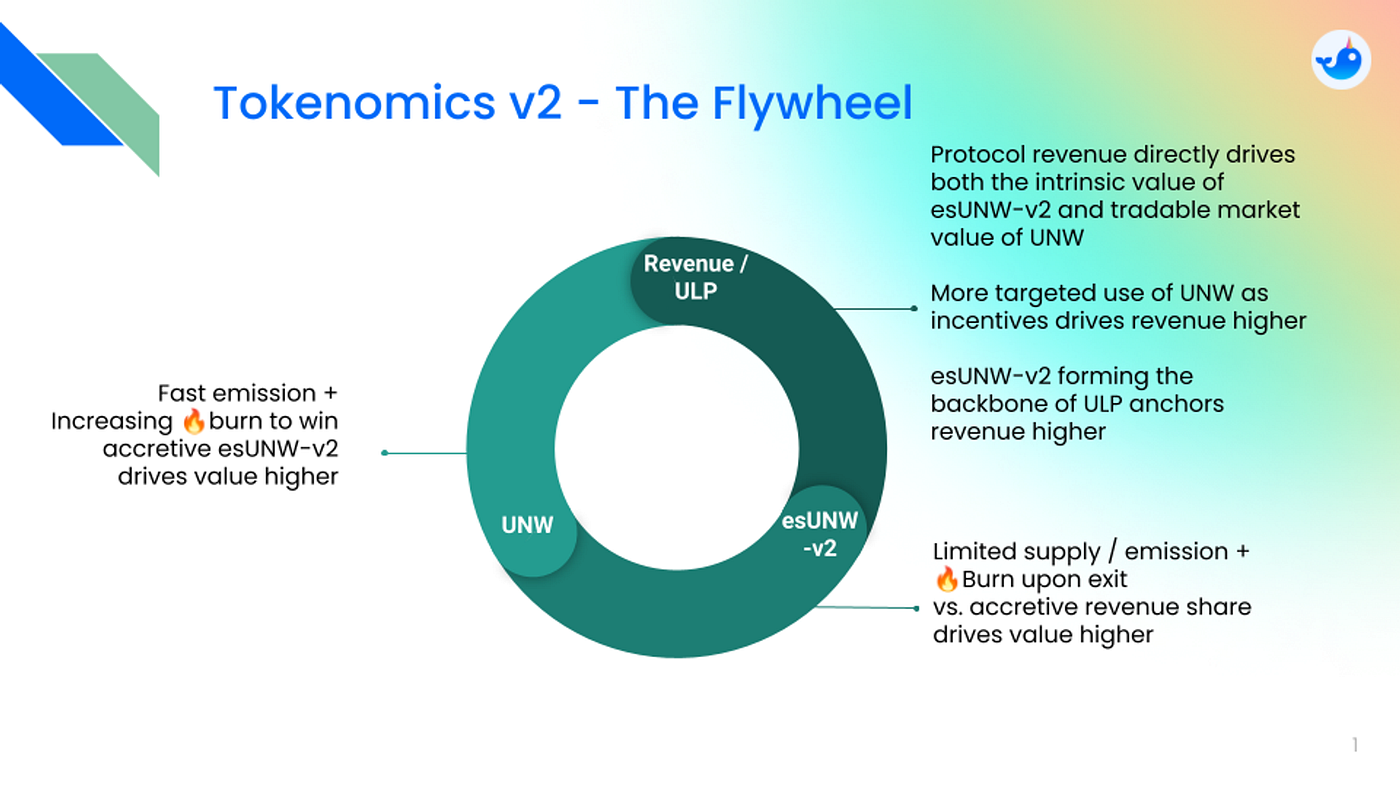
* Protocol revenue directly drives both esUNW and UNW.
* UNW and esUNW complement and create a positive feedback loop.
* Emission is used more effectively to drive revenue higher.

creating the following Flywheel:

<figure><img src="/files/CICSIWL9DiZtEu9FooGj" alt=""><figcaption></figcaption></figure>

## Proposal details

1. Replace esUNW with UNW as the primary emission token,
2. Migration of esUNW to “esUNW-v2”,
3. Introduction of “Fee Vault”, and
4. Introduction of “Hyper Event with Ladder” as part of token emission


# Replace esUNW with UNW as the primary emission token

esUNW was meant to reward the long-term stakeholder of Uniwhale, allow UNW holders to convert to such long-term stakeholders while giving esUNW holders an option to convert back to UNW if they need. While sound in theory, what we observed in practice was the incentives were not attractive enough for UNW holders to convert to esUNW, while the incentives that were allocated to UNW (instead of esUNW) were not attractive for UNW holders to stake, often leading to little reasons to buy and/or stake UNW and thus creating selling pressure.

So the Proposal calls for a clear distinction between esUNW and UNW, with esUNW continuing to reward the long-term stakeholders of Uniwhale but in a way that does not compete with UNW (see “Migration of esUNW to “esUNW-v2””) and for UNW to be the primary tool for incentives for Uniwhale, i.e. be the primary emission token.


# Migration of esUNW to “esUNW-v2”

esUNW should continue as the governance token of Uniwhale, whose holders are rewarded based on their long-term commitment to the protocol.

To serve its narrower but better defined purpose, the Proposal calls for esUNW to stop being the emission token, and be more exclusive.

Specifically, the Proposal calls for esUNW to be upgraded to esUNW-v2 with the following feature:

* Max Supply: 2,000
* Initial Supply: Up to 140 (see “esUNW migration”)
* Emission: 416 per year across staking and auction (see “esUNW-v2 emission”)
* Non-transferable
* Redeemable at the intrinsic value of Fee Vault

## esUNW migration

The Proposal calls that the esUNW holders migrate to esUNW-v2 with a few options to those holders who do not wish to migrate.

Each 50,000 esUNW will be equal to 1 esUNW-v2, considering the maximum supply of 2,000. Given the current circulating supply of c. 7m esUNW, this means the initial supply of esUNW-v2 can be as many as 140, if all esUNW holders choose to migrate.

After the migration, esUNW will receive neither Fee Distribution nor Emission. esUNW that is not migrated may be :

* vested to UNW (linearly over 6 months),
* if converted from UNW, be converted to UNW immediately 1:1, or
* if otherwise, be converted to UNW by burning 50%

## esUNW-v2 emission

* 1 esUNW-v2 per day is allocated to UNW staking.
* 1 esUNW-v2 will be auctioned on a weekly basis, where, for an allocation of esUNW-v2, UNW holders burn UNW.
* Therefore, 8 esUNW-v2 will be emitted every week, annualizing to 416 esUNW-v2.


# Introduction of “Fee Vault”

As part of the governance, esUNW-v2 holders also control Fee Vault, whose value is mapped to esUNW-v2, by allowing esUNW-v2 holders to redeem esUNW-v2 (i.e. burn) against the intrinsic value (proportional) of Fee Vault.

The Proposal calls for the Fee Vault to receive 40% of the Fee Distribution, which is then automatically converted into ULP. This re-investment of fee into Liquidity Pool aligns the interests of esUNW-v2 holders with the ULP holders.


# Introduction of “Hyper Event with Ladder”

Currently 65% of esUNW emission goes to Traders as part of “Trade and Earn”. This is effectively a “fee rebate” model, in esUNW, but our observation has been that it has not been very effective in attracting real users.

So instead of indiscriminately giving out the valuable resources, the Proposal calls for much of the UNW emission to be part of so-called “Hyper Event with Ladder”.

Hyper Event with Ladder is any event organized by the protocol to encourage growth, either in terms of trading volume or in TVL. An example is a trading competition, where the best traders are rewarded with UNW.


# Summary

The Proposal calls for the four proposals to be implemented with the following Fee Distribution and Emission.

|              | Fee Distribution | UNW Emission                             |
| ------------ | ---------------- | ---------------------------------------- |
| ULP          | 50%              | <p>20% <br>(Hyper Event with Ladder)</p> |
| UNW          | -                | 10%                                      |
| esUNW-v2     | -                | 10%                                      |
| Reserve Fund | 10%              | -                                        |
| Trader       | -                | <p>60% <br>(Hyper Event with Ladder)</p> |
| Fee Vault    | 40%              | -                                        |
| Total        | 100%             | 100%                                     |

For your reference, the above compares to the current distribution below:

|              | Fee Distribution | esUNW Emission |
| ------------ | ---------------- | -------------- |
| ULP          | 50%              | 15%            |
| UNW          | -                | 5%             |
| esUNW        | 40%              | 15%            |
| Reserve Fund | 10%              | -              |
| Traders      | -                | 65%            |
| Treasury     | -                | -              |
| Total        | 100%             | 100%           |


# Classic Tokenomics V1.0

*Please note we are* [*in the middle of upgrading Tokenomics*](https://medium.com/uniwhale/tokenomics-v2-sets-sail-a9ef688c84c8) *after UIP-6 was approved by our community.*&#x20;

*UIP-6 addresses some of the key concerns our community has on the existing tokenomics and look to achieve a more coherent tokenomics with the following goals:*

* *Protocol revenue directly drives both esUNW and UNW.*
* *UNW and esUNW complement and create a positive feedback loop.*
* *Emission is used more effectively to drive revenue higher.*

*creating the following Flywheel:*

<figure><img src="https://cdn-images-1.medium.com/max/1600/0*Me4cfNYJOJ6jaECK" alt=""><figcaption></figcaption></figure>

\
The tokenomics of a protocol charts a course toward the decentralization and autonomy of that protocol. Given a common thread of its governance token to bind them, how does an amorphous community weave itself towards a tapestry? Tokenomics is not a series of binary “do or don’t” gates, but of incentives and self-governance as steering mechanisms to guide a community toward maximizing its utility.

Here, we lay out our tokenomics framework, which builds on many good ideas that we saw over the last few years, including veCurve of Curve protocol and esGMX of GMX protocol.

Our community is at the centre of our tokenomics and so we focus on (1) growth of value accrued to our community, (2) fair distribution of the accrued value, and (3) inclusive governance to deliver on the first two focuses.

## Value accrued to our community <a href="#b486" id="b486"></a>

By value, we largely mean the monetary value accrued to our community, i.e. the revenue generated on our platform. So before we talk about its growth, let’s quickly go over what revenues we expect to generate at Uniwhale.

Uniwhale is an oracle-based decentralized on-chain perpetual trading exchange where you can trade, with up to 200x leverage, BTC, ETH, and many mainstream crypto assets, directly from your wallet. So, much of its revenue comes from trading fees, which are:

* Opening fee, that a trader pays when opening a position;
* Closing fee, that a trader pays when closing an open position; and
* Rollover fee, that a trader pays on the margin posted

[Opening and closing fees](https://docs.uniwhale.co/trading#fee) are 10bps at the time of writing. They are directly linked to the trading volume. For example, if the trading volume over a month was $100mn, then the platform revenue due to opening/closing fee for that month would be $100,000.

[Rollover fee](https://docs.uniwhale.co/trading#rollover-fee) is a fixed fee charged per block-height on the margin posted. The amount of the rollover fee a trader pays is proportional to the duration of the open position he or she maintains. The fee rate is different for each crypto asset and is updated periodically.

So the value creation for our community hinges on our increasing the trading volume and trading revenue, and the supply distribution of our tokenomics is designed to achieve that goal. For example, 10% of our token supply is allocated to the token airdrops to early contributors of Uniwhale, [Uniwhale Genesis Pass](https://medium.com/uniwhale/g-e-n-e-s-i-s-p-a-s-s-uniwhale-f63e77344cf9) holders and targeted DeFi users. 40% of the token supply is allocated to community emission, specifically to reward those loyal traders and liquidity providers as well as our community.

## Fair distribution of value accrued <a href="#id-1da1" id="id-1da1"></a>

Focusing on the growth of value accrued to our community is part of the story. What is equally important is a fair distribution of the value accrued. To that end, our tokenomics calls for a distribution of the value accrued to not only the long-term stakeholders but also to the liquidity providers, as well as reserving some to help the long-term stability of the platform.

## Inclusive governance <a href="#id-34af" id="id-34af"></a>

Uniwhale is a community-driven project, owned by our community. Tokenomics therefore must ensure that our value creation is directed by the wishes of our community and evolve based on that. Through community governance, our community can decide all matters relating to Uniwhale, including, but not limited to, opening/closing fee, distribution of value accrued, emission schedule, token supply and reserve fund.

## Three token system <a href="#id-79ee" id="id-79ee"></a>

To achieve such inclusive governance to drive value creation and its fair distribution, we introduce a three token system, which consists of [ULP](/classic-tokenomics-v1.0/ulp-the-liquidity-pool-token), [UNW](/classic-tokenomics-v1.0/unw-the-utility-token) and [esUNW](/classic-tokenomics-v1.0/esunw-the-governance-token).

## Reserve fund <a href="#id-9548" id="id-9548"></a>

Black swan events can happen and do happen. So it is important that we as a community are well prepared for these. Reserve fund acts as a line of defence against such events and helps ensure our community grows in a sustainable manner. Reserve fund may also be used to strengthen the security of our community, for example, paying for the security audit or bug bounties. Initially, the reserve fund liquidity is bootstrapped by the 20 million allocation from the token supply. A portion of the value accrued will also be distributed to the reserve fund. Any and all creator fees from our NFTs including [Uniwhale Genesis Pass](https://medium.com/uniwhale/g-e-n-e-s-i-s-p-a-s-s-uniwhale-f63e77344cf9) will also contribute to the reserve fund.


# ULP - The Liquidity Pool Token

ULP is our liquidity pool token. It is transferrable. Liquidity providers mint ULP when they provide liquidity to Uniwhale. The number of ULP minted is proportional to the amount of liquidity you provide relative to the liquidity balance Uniwhale holds. ULP holders can stake ULP to participate in the distribution of value accrued and the token emission. ULP can be redeemed any time in stablecoins, subject to the minimum collateral requirement rule. The amount of stablecoins ULP holders receive upon redemption is proportional to the number of ULP tokens burnt relative to its outstanding supply.

## Key Summary

#### Token Symbol

ULP

#### Contract address

[0xbdecafd9096d43616a8e0eb8f3fa0865fd4769e7](https://bscscan.com/token/0xbdecafd9096d43616a8e0eb8f3fa0865fd4769e7)

## Become [Uniwhale Liquidity Provider](https://app.uniwhale.co/liquidity)


# UNW - The Utility Token

## Key Summary

**Token Symbol**

UNW

**Contract address**

[0x5b65cd9feb54f1df3d0c60576003344079f8dc06](https://bscscan.com/token/0x5b65cd9feb54f1df3d0c60576003344079f8dc06)

**Max Supply**

100,000,000

#### Token Brief

UNW is our tradeable and transferrable token. Its holders can stake UNW to participate in the token emission. However, its holders do not share in the distribution of the value accrued to the platform.

UNW is not the governance token. Its holders must convert UNW into esUNW in order to participate in the governance. UNW can be converted into [esUNW](/classic-tokenomics-v1.0/esunw-the-governance-token) anytime.

### How to buy UNW?

* Buy on [PancakeSwap](https://pancakeswap.finance/swap?inputCurrency=BNB\&outputCurrency=0x5b65cd9feb54F1Df3D0C60576003344079f8Dc06)
* Buy on [Thena](https://thena.fi/swap?inputCurrency=BNB\&outputCurrency=0x5b65cd9feb54f1df3d0c60576003344079f8dc06)
* Buy on [MEXC](https://www.mexc.com/exchange/UNW_USDT)

### UNW Token Pair

* Provide [UNW/BNB V3](https://pancakeswap.finance/add/BNB/0x5b65cd9feb54F1Df3D0C60576003344079f8Dc06/2500?minPrice=971.012767\&maxPrice=3880.294512) Liquidity on PancakeSwap
* Provide [UNW/BNB V2](https://pancakeswap.finance/add/BNB/0x5b65cd9feb54F1Df3D0C60576003344079f8Dc06/2500) Liquidity on PancakeSwap
* Provide [UNW/THE](https://thena.fi/liquidity/manage/0xd714206a7D63F5a2d613064815995E9CC7061988) Liquidity on Thena


# esUNW - The Governance Token

## Key Summary

**Token symbol**

esUNW

**Contract address**

[0x61c07ec9ca5ff18102396b4fff4eb31d7866d5cf](https://bscscan.com/token/0x61c07ec9ca5ff18102396b4fff4eb31d7866d5cf)

#### Token Brief

esUNW is our governance token. Only the holders of esUNW can participate in the governance of Uniwhale. It is a non-tradeable and non-transferrable token, that can be staked to participate in the distribution of the value accrued as well as in the token emission.

The token emission is also in form of esUNW. esUNW holders can convert esUNW into UNW by locking up esUNW over 6 months, over which esUNW will be converted into UNW linearly per block. Locked esUNW (for vesting) may be unlocked anytime.

Locked esUNW also ceases to be subject to any distribution of the value accrued and the token emission.

### How to earn esUNW

* Become [Uniwhale Liquidity Provider](https://app.uniwhale.co/liquidity)
* [Trade and Earn](https://medium.com/uniwhale/trade-and-earn-your-scorecard-e1b4687d036)
* [Stake](https://app.uniwhale.co/earn) esUNW or UNW
* Uniwhale [Referral](https://app.uniwhale.co/referral) Program


# Revenue Distribution and Emission

### Platform Revenue Distribution

Subject to governance, 100% of the revenue generated on the platform may be distributed to our community. The current distribution percentage is as follows.

<table><thead><tr><th width="512.5"> </th><th>% of Distribution</th></tr></thead><tbody><tr><td>Staked ULP (<a href="https://snapshot.org/#/uniwhaleex.eth/proposal/0xc6feb05327d484ee9f6917be3ef77a96d9a234d53c76b88106886d2b2d03a47e">Reinvested</a>)</td><td>50%</td></tr><tr><td>Staked esUNW</td><td>40%</td></tr><tr><td>Reserve Fund</td><td>10%</td></tr></tbody></table>

### Token Emission

All emissions are in esUNW, with a few exceptions including rewards provided to external partners.

<table><thead><tr><th width="242"> </th><th>Daily Emission (approx.)</th><th>% of Emission</th></tr></thead><tbody><tr><td>Trade and Earn</td><td>36,140 esUNW</td><td>65%</td></tr><tr><td>Staked ULP</td><td>8,340 esUNW</td><td>15%</td></tr><tr><td>Staked esUNW</td><td>8,340 esUNW</td><td>15%</td></tr><tr><td>Staked UNW</td><td>2,780 esUNW</td><td>5%</td></tr></tbody></table>

#### APR

The formula for the Annualised Percentage Return ("APR") is as follows:

`APR = 7-day average of (APR for block)`

`APR for block = Total payout for block x no. of blocks per year / (total staked value for block in current USD)`

`Total payout for block = (total platform revenue distribution for block in current USD + total emission for block in current USD)`


# Token Distribution

<table><thead><tr><th></th><th width="209.66666666666669">Amount</th><th>% of Max Supply</th></tr></thead><tbody><tr><td>Airdrop</td><td>10,000,000</td><td>10%</td></tr><tr><td>Emission Rewards</td><td>40,000,000</td><td>40%</td></tr><tr><td>Liquidity</td><td>10,000,000</td><td>10%</td></tr><tr><td>Reserve Fund</td><td>20,000,000</td><td>20%</td></tr><tr><td>Team, advisor, and marketing</td><td>20,000,000</td><td>20%</td></tr></tbody></table>


# Comparison of UNW and esUNW

Given the nature of [esUNW](/classic-tokenomics-v1.0/esunw-the-governance-token), its holders are subject to a higher percentage of the value accrued and the token emission, compared to [UNW](/classic-tokenomics-v1.0/unw-the-utility-token).

<table><thead><tr><th width="252.66666666666669"></th><th width="264">esUNW</th><th>UNW</th></tr></thead><tbody><tr><td>Platform Revenue Share<br>(Staking Required)</td><td>40%</td><td>-</td></tr><tr><td>Emission Share<br>(Staking Required)</td><td>15%</td><td>5%</td></tr><tr><td>Governance</td><td>Yes</td><td>No</td></tr><tr><td>Transferrable / Tradable</td><td>No</td><td>Yes</td></tr><tr><td>Note</td><td>Can be locked to vest to UNW over 6 months linearly</td><td>Can be converted to esUNW any time</td></tr></tbody></table>

## How to convert esUNW to UNW?

Once you lock to vest esUNW, you will receive UNW every block linearly for 6 months (you need to claim vested UNW). You can stop vesting and unlock esUNW any time.

For example, Alice has 180 esUNW, and she locks to vest esUNW, then she can receive 1 UNW everyday by each block.&#x20;

## How to convert UNW to esUNW?

You can convert UNW to esUNW any time by clicking the convert button.&#x20;


# Uniwhale Genesis Pass

### **A Limited Drop of Genesis Pass NFTs**

<figure><img src="/files/UyEu728X6J5d99RXiXWA" alt=""><figcaption></figcaption></figure>

Uniwhale Genesis Pass consists of 10,000 OG membership NFTs with premium platform benefits. Your keys to access full privilege for trading and earning on Uniwhale Exchange:

* 20% discount on trading fees. (The rate of the Referral Code will not apply when NFT is staked.)
* 10% reduction in spread for trading.
* 5% yield boosting for staking.
* Governance token airdrop.

Pass will be free mint for whitelist members. Additional benefits will be added as the platform grows. See details in the #whitelist-rules channel of our [Discord server](http://discord.gg/Uniwhale) for how to become whitelisted.


# Roadmap

#### Stage 1

* Kick-off of a series of campaigns
* NFT Whitelist giveaways
* Uniwhale 1.0 Public Testnet Launch

#### Stage 2

* Genesis NFT mint
* Tokenomics publish
* Token Generation Event (TGE)
* Oracle aggregator design and implementation
* Uniwhale 1.0 Mainnet Launch

#### Stage 3

* Airdrop for early participants and NFT holders
* Airdrop for DeFi users
* Open liquidation bot API for NFT holders
* Free trading campaign
* Mobile App

#### Stage 4

* Multi-chain launch
* Uniwhale 2.0 Option Trading Testnet Launch
* Built on Quant Strategy Launch


# Social Media

Twitter: <https://twitter.com/UniwhaleEx>

Discord: <http://discord.gg/Uniwhale>

GitHub: <https://github.com/uniwhale-io>

Medium: [https://uniwhale.medium.com](https://medium.com/uniwhale)

Dune: <https://dune.com/uniwhale/uniwhale-overview>

DefiLlama: <https://defillama.com/protocol/uniwhale>


# Terms and Condition

IN ACCESSING AND/OR USING UNIWHALE EXCHANGE, YOU ACKNOWLEDGE AND AGREE THAT :

(a) UNIWHALE EXCHANGE IS/ARE PROVIDED ON AN “AS-IS” AND “AS AVAILABLE” BASIS, AND UNIWHALE EXCHANGE COMMUNITY (“OPERATOR”) AND ITS AFFILIATES (SAVE TO THE EXTENT PROHIBITED BY APPLICABLE LAWS) EXPRESSLY DISCLAIM ANY AND ALL REPRESENTATIONS, WARRANTIES AND/OR CONDITIONS OF ANY KIND IN RESPECT THEREOF, WHETHER EXPRESS, IMPLIED, OR STATUTORY, INCLUDING ALL WARRANTIES OR CONDITIONS OF MERCHANTABILITY, MERCHANTABLE QUALITY, FITNESS FOR A PARTICULAR PURPOSE, TITLE, QUIET ENJOYMENT, ACCURACY, OR NON-INFRINGEMENT.

(b) OPERATOR AND ITS AFFILIATES HAS NOT MADE AND MAKES NO REPRESENTATION, WARRANTY AND/OR CONDITION OF ANY KIND THAT UNIWHALE EXCHANGE WILL MEET YOUR REQUIREMENTS, OR WILL BE AVAILABLE ON AN UNINTERRUPTED, TIMELY, SECURE, OR ERROR-FREE BASIS, OR WILL BE ACCURATE, RELIABLE, FREE OF VIRUSES OR OTHER HARMFUL CODE, COMPLETE, LEGAL, OR SAFE.

(c) YOU SHALL HAVE NO CLAIM AGAINST OPERATOR AND/OR ITS AFFILIATES IN RESPECT OF ANY LOSS SUFFERED BY YOU IN RELATION TO OR ARISING FROM YOUR ACCESS AND/OR USE OF UNIWHALE EXCHANGE.


# Smart Contracts

<table><thead><tr><th width="258">Contract</th><th>Address (BNB)</th></tr></thead><tbody><tr><td>Trading Core</td><td><a href="https://bscscan.com/address/0x2926710dcb5c3e046285755410979d1de5fcc1ea">0x2926710DCB5c3e046285755410979D1DE5fCc1Ea</a></td></tr><tr><td>Trading Core with Router</td><td><a href="https://bscscan.com/address/0xdaf311cd286bc7094487afc306f6ff3681cff129">0xdAF311cd286bC7094487AFC306F6Ff3681cfF129</a></td></tr><tr><td>Limit Book</td><td><a href="https://bscscan.com/address/0x656aC046304446C5802849FCfD5F5DDb090A8ea7">0x656aC046304446C5802849FCfD5F5DDb090A8ea7</a></td></tr><tr><td>Liquidity Pool</td><td><a href="https://bscscan.com/address/0xbdecafd9096d43616a8e0eb8f3fa0865fd4769e7">0xBdeCAFd9096D43616a8E0eB8F3fa0865fD4769E7</a></td></tr><tr><td>Margin Pool</td><td><a href="https://bscscan.com/address/0xbb1b941ab76fae4e9f552b860efac1f367ac9bcc">0xBB1B941aB76fAE4e9F552B860eFaC1F367AC9bCc</a></td></tr><tr><td>Registry Core</td><td><a href="https://bscscan.com/address/0xae0c4a3432b18d9c65e1544a7669d9de44927ff9">0xae0C4a3432b18d9C65e1544a7669d9De44927ff9</a></td></tr><tr><td>Oracle Aggregator</td><td><a href="https://bscscan.com/address/0x0b56a61d817e215d6f6dc7b461be2e5b0ca3716b">0x0b56a61d817E215d6F6dC7B461BE2e5b0ca3716b</a></td></tr><tr><td>Uniwhale Genesis Pass</td><td><a href="https://bscscan.com/token/0x3d8ce31601b8ed4db5eeb921fcf7f178babe7c2e">0x3D8cE31601b8ED4Db5eEB921FCF7f178bABE7C2E</a></td></tr></tbody></table>


# Testnet Trading Competition

<figure><img src="/files/v3r5Trtgk2PJpe4er5Vb" alt=""><figcaption></figcaption></figure>

**Start date**: January 30, 2023

**Duration**: 2 Weeks

## Rules: <a href="#b509" id="b509"></a>

* Get your trading funds from the Uniwhale [Testnet Faucet](broken://spaces/0xEle6Jl265gogxiAp8X/pages/nz8vS0ybQnPbVHz4JFtL) page.
* No registration or KYC required to participate in the competition. Simply use the [Uniwhale Testnet](https://app.testnet.uniwhale.co/).
* There will be a number of trading sessions over the two weeks and you can participate in as many as you like.
* Each trading session lasts 48 hours, with the starting time of each session announced on [Discord](http://discord.gg/Uniwhale).
* You will be a winner for a trading session, if your session ROE (net PnL over margin used) is in the top 3!

## Rewards: <a href="#id-025a" id="id-025a"></a>

* The first-placed winner receives 50U.
* The second-placed winner receives 30U.
* The third-placed winner receives 20U.
* The winners will receive airdrop boosts at the **Uniwhale** **Mainnet Airdrop Event**.
* The winners will also receive the **Uniwhale Genesis Pass whitelist.**
* If two addresses have the same ROE, the address with higher trading volume ranks higher.

## Rewards and Announcement Time: <a href="#id-81ee" id="id-81ee"></a>

* **Start Time + 48 hours = End Time**\
  Please note only those trades opened after Start Time will count.\
  All open position will be automatically closed at End Time.
* After each trading session, we will announce the session results together with the new session time on the Discord Announcement channel and distribute rewards.
* The winners’ airdrop boost points will be automatically accumulated on the Airdrop Dashboard (coming soon).
* The winners can claim NFT whitelist on [Discord](http://discord.gg/Uniwhale). Please note the whitelist can be claimed only once.